Talks
Ian Mather – Retford Little Theatre
Ian started by speaking of his birth in Lancashire in 1941, his move to Hove which involved a change in pronunciation of his surname and his arrival in Retford in 1987.
He ran through the history of the Retford little Theatre since1941 at various locations including behind Clark’s Dye Works, the Town Hall and Wharf Road. For such a small theatre the number of productions is quite surprising – the 100th production in 1959, the 200th in 1979, the 300th in 1999, the 400th in 2019 and the 427th in May 2026.
In addition to the plays, the theatre started showing films ten years ago and has shown a hundred so far.
Alan Withington – Cyanotype Photography
Alan described himself as an alternative process photographic artist and went on to describe his background since leaving school in the 1980s, and said this included photography using film. He said he had experimented, amongst other techniques, using film lenses and digital equipment.
During his presentation Alan did some practical work to demonstrate aspects of his techniques and used leaves from the car park to create images. He said that the techniques lent themselves well to the re-creating of old photos and he showed examples of Gillian Hattley-Warnes’ photos as used in her book ‘Little Me’. He went on to show examples of restored photos that Derek Taylor had sent him prior to the meeting as damaged positives.
Alan was passionate about his subject and said that he had not just wanted to talk about his subject but also to show us and to help us understand why cyanotype photography still exists in these days of digital photography
James Ince – The Night Sky
From the start James showed that he was passionate about his subject and he delivered a fast moving and concentrated presentation in a way that was also understandable to the layman. He covered the moon, the sun, solar eclipses, nuclear fusion and magnetism, various planets, various constellations, nebulae, galaxies, the Milky Way, some exotic stars, red giants and black holes.
He explained his telescope and said that amateurs should start with binoculars and said that those with a 50mm lens and 10X magnification could be purchased for around £30.
Derek Taylor – The Last Projectionist
In a change to the scheduled talk Derek Taylor, our Speaker Finder, gave his talk on his experience as the Last Projectionist at the Regal Cinema Worksop. Derek began with the history of the Regal which in addition to the films the cinema hosted many touring pop artists and bands, and local amateur dramatics. Derek reminisced about some of the artistes. He went on to described what was needed to prepare a film for for projection – from joining the many spools onto one, and the many other tasks needed during and after the show.
Brian Tunnard – Cloud Hopping
Brian Tunnard brought his powered para-glider, his personal flying machine, and took us aloft for and interesting morning. Brian who took up para gliding when he retired, told us about the equipment , regulations and how he learnt to fly.
He took us a a flight from Worksop over Sheffield and into a snow covered Derbyshire, before returning to Worskop.
Stephen Gay – Sheffield to Cleethorpes (part2)
A last minute change of speaker due to illness, gave Stephen Gay the opportunity to continue his journey to Cleethorpes . This included a diversion to Burton on Humber and the ferry port on the south bank of the Humber for the ferry to Hull station; it used to be a major line before the ferry stopped with the opening of the Humber Bridge.
Hopefully, in Part 3, we will enjoy the remaining stations and arrive in Cleethorpes.
Stephen Gay – Sheffield to Cleethorpes
Stephen Gay presented the first part of his talk on the railway from Sheffield to Cleethorpes. He set the scene by starting with host wonderful photos of several, now demolished, railway and other buildings in Sheffield before continuing with his journey towards Cleethorpes, describing things along the way. He had slides of the collapsed embankment near Wales with several meters of unsupported line, that closed the line for several months. he showed where 4 lines were reduced to 2, and several sidings for coal mines. We learnt why the lift at Retford Lower Station was not installed for passengers, but for newspapers.
We look forward to continuing the journey to Cleethorpes
Neil Moore – Astronomy
Neil Moore was a last minute stand-in speaker when the booked speaker was snowed in in Sheffield.
Neil presented another of his talks, this time related to aspects of astronomy.
Neil gave a fascinating talk, which really caught the imagination of many of the members present, based on the comments made and the questions asked.
He spoke of his previous membership of an astronomical society in Doncaster and previous talks he had made on the subject.
He told us that Polaris had not always been the Pole Star and described the relationship between the earth, sun, Polaris and Orion. He went on to speak of the relationship between the earth and the moon, the moon not being in a stable orbit. He said that historically the moon had been closer to Earth and in the future the same. He said that the moon presents the same face to the earth albeit with a wobble. He said that Patrick Moore would research both the left side and the right side when each became visible.
Budget Planning by Karen Ludditt and Alicia Thompson
This was an enlightening and interesting talk on the Budgeting of Bassetlaw District Council. Karen explained about the annual, 3 year medium planning periods, and how the Council Tax was divided between Nottinghamshire and Bassetlaw Councils. Bassetlaw only receive 8% at £21.40 for each house. We then learnt how the this money was used to provide the Council Services.


Alicia described the Budget Conversation on what residents and visitors wanted from the Council and how it balanced it’s budgets. We were all invited to complete the Conversation either in the hard copy or online
History of Flight – Keith Small
Keith Small presented “Those Magnificent Men in Their Flying Machines”. Keith started started with Icarus with his wings of feathers and wax, followed by people jumping from a height.
The first successful flights were with paper balloons filled with smoke / hot air from a fire which rose into the air, through the developments from lifting animals to people, to dirigibles by Zeppelin which had carried 3500 passengers before WW1. Keith then moved on to unpowered flight using Bernoulli’s theorem with aerofoils. …….
Victorian Optical Toys – Bob Massey
Bob Massey, who presented ‘Victorian Optical Toys’. Bob set the scene by saying that in Victorian times entertainment was mainly in the home. He said that the origins of cinema were probably in the Stone Age when the light from the fire was used to create shadow images and this technique continued through the centuries. Bob described and passed around an array of Victorian toys, many of which were quite ingenious. He said that children did not go out to the theatre, except to pantomimes, and that when parents went out to the theatre they might bring back a model theatre or items related to what they had seen.
25 years in the RAF – Peter Pascoe
Peter Pascoe returned for a second talk after his training in fast jets. He transferred to flying the Westland Whirlwind HAR10 helicopters initially in Singapore and then the war the Far East.
Peter had two weeks conversion to helicopters, followed by dry winching and navigation training and then in February 6,3 rescuing at RAF Valley on Anglesey.
He started with a photo of himself in 1952, aged 18, dressed in WW2 flying kit with a Tiger Moth. In the early sixties he volunteered for service in the Far East and was surprised to be posted to Westland Whirlwind HAR10 helicopters. He went from thinking it would be terrible but it turned out very good. In 1963 he was posted to RAF Valley from where he practiced rescuing from the sea. He said that rescue depends on the winch operator’s directions as the pilot cannot see. He said it was very cold there and he and the crew were revived with coffee and rum after each return before going out again.
He was posted to Singapore where he went with his family. When he arrived there he found there was a commander but nothing else. When the aircraft arrived he was able to do jungle training in Borneo. He said that the initial maps had no contours and this was very dangerous for pilots because of the low cloud over the jungle. These had to be added as they became known and, by coincidence, one of our former Probus members, the late Mike Vickers was in Borneo at the same time surveying the territory and working from sea level through to the top of the mountains enabling others to develop the contour lines over the island.
Peter and his family seemed to enjoy their time in Singapore and he spoke of a good social life and the restaurants and bars. One downside he and his family had was that there were numerous snakes in and around their bungalow but they were able to swap it for an apartment.
When he returned to the UK he undertook rescue duties, mostly picking up seamen
off trawlers, and he said the unit was like a big family.
Where have I heard that Rhyme Before? – Sam Millard
Sam presented a History Mystery – Where have I heard this before. He started with three completely different stories.
The first was about George Villiers, 1st Duke of Buckingham who was a favourite of King James 1, the second was on the Civil War and the siege of Colchester and St Mary’s church tower where they had placed a cannon which protected the town. The third was Richard Plantagenet and a battle in the War of the Roses at Sandal Castle.
The link was they all are told in well known Nursery Rhymes. Sam continued with more tales from history that are all re-told in Nursery Rhymes such as Humpty Dumpy, The grand old Duke of York, Little Jack Horner and Georgie Porgy which all related to the tales he had told.
AGM & Talk
Philip Laming was installed as Chair at the AGM.
Following the meeting Neil Moore gave a talk on the life and eccentric behavour of the American ‘Lord’ Timothy Dexter (1747 – 1806) of Newburyport, Massachusetts, who became wealthy through a series of unlikely investments.
Engineering Oddities – Paul Adey
Paul rapidly ran through various engineering achievements including some, from what we know now, should not have been possible. He spoke of precision granite cutting of 4000 years ago, quite lengthy aqueducts from Biblical times and a flour mill of a similar time with a daily capacity of4.5 tons.
He then moved on to the 19th Century and described various engines which must have been incredibly difficult to conceive and just as difficult to manufacture with available resources of the time.
He then described some 20th Century inventions including fire control systems, engines, battle tanks, aircraft and even the Deltic engine.
Brush with the Stars – Chris Hewis,
Chris was making a repeat visit having first presented Part 1 of his talk to us a year ago. He described himself with the phrase ‘A wandering minstrel I shall be’. His musical career had started in the 1960s and he said that he had also worked for the Home Office as an accountant for the prison service. He said that this was quite normal for musicians and said that most orchestral musicians are also music teachers. He spoke enthusiastically of his various seasons and other performances and of the multiplicity of musicians and bands he had worked with over the years. Chris was a drummer and played as a session musician in many film soundtracks, he also played in the band that played at Margaret Thatchers’ major set-piece speeches on her general election campaign
Bassetlaw Conservation Areas – Michael Tagg
‘Michael Tagg talked about the role of Bassetlaw Council and the Planners in protecting the many historic listed buildings and areas in the region. How the assist the owners to maintain and enhance their buildings, using as an example the Eyres’ store in Worksop.
Michael then went on to talk about the history of Worksop Manor, from it’s ownership which included the sale in 1839 from Duke of Norfolk to4th Duke of Newcastle, and development . The Park extended to Shireoaks Hall. A new hall was designed in 1745 but the building was only partially completed.
Tricks of Light and Colour – Bob Massey
Bob Massey kept us all enthralled and engaged in what we each saw in his slides. Our brains interpreted / identified letters in his images. Bob discussed how our interpretations depended on the languages and alphabets we know – by ‘adding’ lines we could see letters, different people saw different words due to the contrasting colours. Bob went on to test our colour blindness and identified that there were at least three version in the room. A very entertaining morning.
The Holocaust and Little Me – Gillian Hatley-Warnes
Gillian Hatley-Warnes presented a very moving account of her mother and other family members in a Ukrainian village and then in Prague during Nazi rule in the early 1940s. Her sixteen year old mother with her brother had tickets to go to America but needed to first travel via Vienna. When they arrived in Vienna all the men were taken away and one in ten of the remainder were shot. After this, her mother and other women were boarded boats and sailed to and then around the Black Sea and Mediterranean with no port prepared to let them land.
At Haifa the British would not let them land but put them on a ship for America which blew up. Gillian’s mother escaped through a porthole and was taken on shore and spent two weeks in a hospital and a year in an internment camp after which time she and others were released to fend for themselves.
She saw an advert for the ATS and joined up in Egypt where she met her husband, an army officer, were married in Cairo and, after the war, settled in Britain.
The speaker did search for her family, and was able to confirm via quite good records that most had perished and others could not be found.
Social Media – the Good, the Bad and the Ugly by Jonathan Brassington and Elisha Simpson,
Jonathan Brassington and Elisha Simpson started by describing their backgrounds – one in public relations and the other in social media, both for the local Council. They suggested that early forms of this type of communication could even be Semaphore and Morse. The internet had gone nationwide by 1998, particularly at universities and it really got going over the next decade with Facebook starting in 2004 and now, in the UK, 56.2 million people or 82.8% of the population are using social media. Elisha spelt out which population groups favoured which platforms, with, for example, the over 65s favouring Facebook.
She said that the Good was that it was free, instant and widely used.
The Bad was the decline of the local press and local radio and the fact that anyone can post anything whether true or not. People tend to respond too quickly, often unpleasantly expressed, to what they read without understanding properly what they are reading.
The Ugly includes online hatred, suicides following abuse, misinformation with real life consequences such as riots in cities in various cities following the Southport murders.
Houses of Parliament by Mike Ogden
Michael set the scene by describing the London of a thousand years ago, with rivers such as the Tyburn flowing through open farmland. Today the Tyburn and some other London rivers flow underground. Michael then described the gradual development of buildings such as the Palace of Westminster, St. Stephen’s Hall, Westminster Hall and others nearby and the involvement of various monarchs with Henry VIII being the last resident of the Palace of Westminster.
He spoke of Guy Fawkes and the Gunpowder Plot and the competition in the 19th Century to choose a design following destruction of the old palace by fire. He said that Charles Barry had won the competition and that stone from North Anston had been used, transported via the Chesterfield Canal to the River Trent, down the coast and up the River Thames to Westminster
The History of Morris Dancing by Chris Rose
Chris started Morris Dancing in the mid 1970s, he is a member of Rattlejag Morris in Retford. Most people think of Morris Dancing as that recorded in Oxfordshire and Gloucester, whereas the dances and music developed separately over hundreds of years in various parts of England. Early music was played on a Drum and Tabor.

Some of these different styles have survived to this day and, for example, the Lancashire and Cheshire tradition is very different from the Cotswold style. Chris said that there was ongoing work to find dances and music from various parts of the country where records had been lost.
The Morris Federation has a website https://www.morrisfed.org.uk/ which gives details of active groups along with information and videos.
25 years in the RAF by Peter Pascoe
Peter spoke of the nine hundred thousand British and Commonwealth military personnel who had died during WW1 and the fewer than half this number who had died in WW2. He said the statistics were the opposite way round in the case of civilians and this was largely due to the nature and extent of combat in the air.
Peter said that he came from a family with a military background of two hundred years. His own service included three years in training, seven or eight years in fighter command and then helicopters. Peter started by remembering the many airman that had died since WW2; these included a number of his friends and colleagues who had died in training. Peter joined the RAF on National Service and trained as a pilot, first in a Tiger Moth and later in a Meteor when he was based at RAF Worksop at Scofton. He commented that, since WW2, the military had been deployed eighteen times either in war or to support governments. He spoke of problems with various aircraft and said he had lost more than forty friends in crashes.
He went on to describe his background growing up in the forces, being called up for National Service, undertaking intelligence and selection tests and being offered a pilot’s role. Subsequently, owing to a surplus of pilots he chose to become a navigator, training in Canada.
Electric Cars by Martin Rowley
Martin Rowley established his credibility by saying that he had driven 51 different electric cars and that his wife had had the same Toyota Auris hybrid for eleven years, covered 6600 mile and had no plan to change it.
He ran through the history of electric cars starting in the late 19th century and through the twentieth century and highlighted the four lunar rovers from the 1970s and the 4444 US postal delivery vehicles from the 1990s.
He ran through the three main types of electric cars: Hybrid self-charging, Plug in hybrid, Fully electric, and also mentioned hydrogen, which for now is used mainly in some buses and trucks and has only four filling stations in the whole of England.
The key issue is the origin of the batteries and currently these are made in:
China 56%, Korea 26%, Japan 10%, USA 6%, Europe 4%
The Chinese government in particular has been subsidising the export of electric cars made by a raft of new Chinese car manufacturers with various western governments levying import duty of 50% or even 100% to deter such dumping and to protect their own manufacturers.
Lithium batteries are becoming old hat now and being replaced with solid state batteries with a life of thirty years. These, together with the ability to fully charge in ten minutes overcome the reluctance that many experienced motorists have had about electric cars. He also mentioned induction charging by just driving along a special track as well as a ten minute battery swap as practised in some markets.
He said that a good way to help decide which electric car to buy is to look at what taxi drivers are buying. Currently it is the Toyota Corolla.
Looping by Nick Robinson
Nick demonstrated how electric guitar playing has changed over the decades from a guitar with a volume pedal and possibly a fuzz box to to sophisticate amplifiers with ever changing sound processing aids. Each band had its own sound from the amplifiers etc that they used such as reverb which started with a large box with a speaker at one end and a mic at the other.
Today all of the many amps and features are reproduced on a piece of software on a laptop, which can help reproduce the effects used by well known guitarist from Hank Marvin, Fleetwood Mac to to Brian May
On the screen you can select your chosen Amplifier etc.. Nick demonstrated on his guitar the many feature, available at the click of a mouse, and reproduced the sounds and effects of the lead guitarists we all remembered.
Nick demonstrated how to record a short track which could be manipulated to repeat in a loop, with changes of speed and frequency, and finally demonstrated how Tubular Bells was made.
A most interesting and informative lecture on the history of electonic sound.
Early Worksop families by Benedict Jephcote
Land speed record by Paul Adey
The talk took the form of a list of the records starting with the first six records in 1898 and 1899, which were all achieved by electric vehicles, through to 2001 when the current record was set. He described some of the records with just the date and speed but many of the others with more of a story.
Brush with the Stars by Chris Hewis
A talk, as he said, essentially about himself in theatre and entertainment starting straight from school in 1960 and covering the next fifty years or so. His first professional role was the back end of Daisy the Cow but was promoted owing to the sickness of the front end actor. He worked in theatres, acted in theatre and film and became an accomplished drummer. He spoke of, and showed photos of, actors he knew, some of whom he first met in his very early days at Lincoln Theatre


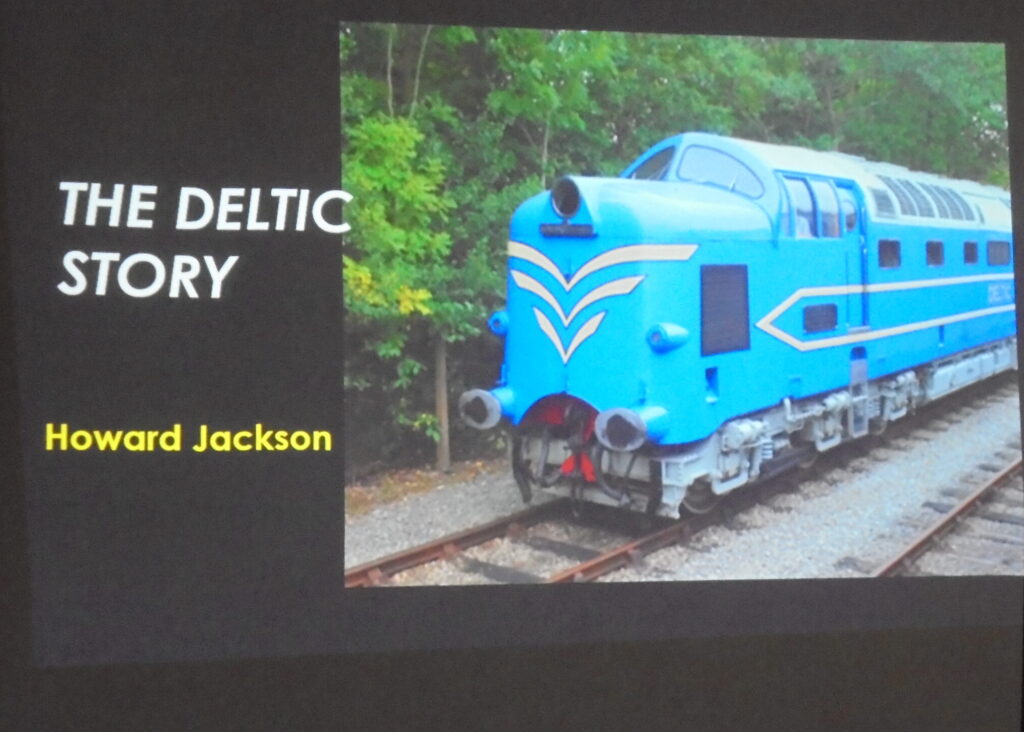
The Deltics by Howard Jackson
Howard started with a quick overview of the engine comprising three banks of six cylinders arranged in the shape of the Greek letter delta. He went on to tell the history from the early twentieth century to fairly recent times of the various design and manufacturing companies involved in aeronautical, marine and railway locomotive applications.
Howard went into the arrangement of the pistons and crankshafts and used moving diagrams to demonstrate how they moved, two crankshafts in one direction and the third in the opposite.
It was very evident that Howard had a huge amount of material as well as extensive knowledge of his subject and must have spent a great deal of time putting it together as a presentation.
There was in fact so much material that he seriously overran the allotted time despite speeding up at the end. The presentation was very well received by members


Retford and Worksop Brewery by Dave Pickesgill by John Stock
This is the story of a brewery that was typical of many independent breweries, yet unique in its creative use of marketing and iconography. This talk will cover the origins of the brewery in 1881, then follow a potted history for the next 80 years before the 1959 takeover by Sheffield Brewers, Tennants and the subsequent demolition in 1962. Along the way we will mention the annual almanac, Worksop luminaries, malting, the Old Albion Brewery, current-day remnants and much more.
The Worksop & Retford Brewery was a large employer and a landmark enterprise for the whole of Bassetlaw. Worksop malt was critical to the success of brewing operations in Manchester and the Midlands. Victorian photographs provide an indication of the sheer size of the operation. Ornate wrought iron gates opened out onto a large eye-catching and decorative five storey building, built from bricks of different colour in a style in favour at the time. It was taken over by Tennants in 1958 and demolished in 1962.
The almost forgotten story of what was once one of the town’s foremost industries tells a story of a brewery that was both typical of many regional, independent breweries, and yet also unique in its creative use of marketing and iconography.
School of Artisan Food by David Carter
David Carter from the School of Artisan Food at Welbeck introduced himself as a former solicitor, who has a second career at the school and is currently the Patisserie Tutor at he school. After retiring he enjoyed baking and experimenting and had been on a two day baking course and subsequently asked if there were any jobs available. he heard on Radio 4 ‘s Food Programme, that the school were starting an one year course on Artisan Baking and Patisserie. He applied and was was informed that he needed to write a dissertation on the reasons he should be on the course as soon as possible. After a busy weekend writing it, his application was successful and he spent a year on the course. The day before the final 8 hour practical, he was offered the job of Baking Coordinator. After an exhausting day of the final practical he passed the course.. His job involved demonstrating at events such as RHS shows and on TV for historical baking and some teaching. Then Covid happened, after it the School needed to restructure and he was responsible for work placements. After 13 years David will retire in a few weeks.
The School of Artisan Food is in part of the building that was once the old fire station on the Welbeck Estate. When the Alison Parenté who oversees the Welbeck Project, in 2009 had great difficulty in finding bakers of sourdough bread the UK for the Welbeck Bakery, this lead to the formation of the School of Artisan Food which opened in 2011. The School ; it runs courses mainly involved with fermentation related to food and drink qualifications, from diplomas to degrees, and lots of short courses. It has won many awards. It has modern equipped rooms for baking, meat butchery, smoking etc, and chess making, many with original features from the fire station, stables etc.
Build a Boat and Sail Away by Andrew Beard
Andrew Beard had sailed for a number of years in dinghies from Cadets to OKs in Sheffield and then in yachts at Abersoch. He had experience of building a Cadet and a Tempest. Having found a warehouse where he would be able to build a boat, he bought the plans for a 31 foot catamaran. He purchased the timber and many sheets of ply required, and with several friends started building the first hull. Before it was finished he had to move move out of the warehouse and with his new partner bought a house with a large garage and front garden, where he was able to complete the first hull. After sailing on the designers own catamaran, he decide to make some changes to the height of the cabin and the location of the loo. The building of the second hull took much less time than the first. After four and a half years of toil, the boat was finished and transported to Abersoch for launching. on the first sail the speed crept up to 10 knots and Andrew was delighted with both its handling and performance.. Thus talked about the joys of sailing from Abersoch including over many of years, including running at 16 knots from a hurricane along the coast to safety in Portmeirion and the return to Abersoch where 70 boats had been sunk or washed up on the beach, a lucky escape. After three years he sold the boat for a more substantial boat with a more powerful engine, with more happy years sailing.

Children’s Air Ambulance by Andrew Jarvis and Lincs & Notts Air Ambulance by Helen Hall
Andrew Jarvis was joined by Hellen Hal for a talk on both the Children’s Air Ambulance and the Lincs & Notts Air Ambulance. Helen started volunteering after a family member needed an air ambulance when on holiday in Cornwall, which 14 minutes by air instead of 40 minutes by land to get to hospital. The air ambulance is funded by donations, however the doctors are seconded from the NHS. A pint of blood cost £50, and each fight costs £4000. Lincs & Notts need to raise £8 million each year; a good source is their Lottery
The Children’s Air Ambulance is different to the regular air ambulance in that they don not respond to accidents but transport critically ill children from one hospital to another and can transport the medical team. Their are two air ambulances, one based at Gamston and the other in Oxford, the cost per mission is £3600. The charity has 52 shops and require £12m year. Each helicopter has 4 seats, one for a parent or guardian. In 2023 they acquired the first incubator for a rotary aircraft. Not all hospitals have helipads, Sheffield Children’s Hospital are installing one at a cost of £6m
Andrew Jarvis became a volunteer after in 2021 he collapsed with a cardiac arrest when he was an assistant referee at a football match; he was given CPR and was defibrillated at the side of the pitch. He was flown in the Derbyshire Air ambulance to Derbyshire Royal Infirmary. He walked out of the hospital


The Goodwood Revival by Martin Rowley
Martin Rowley who was dressed in the appropriate clothing for ‘The Goodwood Revival’.
Martin got into motor sport when he was young – driving, marshalling, and watching; he said F1 was getting boring with the likes of Michael Schumacher, Lewis Hamilton and Max Verstappen.
The Goodwood Revival is something different.
Goodwood is owned by Duke of Richmond and run by Charles, Earl of March, his son; it was a WWII airfield, it is still a working flying school. The Goodwood Motor Racing circuit opened in 1948 and closed in 1966; the Revival started in 1998 initially for pre 1936 race cars. Spectators are expected to dress up in 40s, 50s and 60s styles.
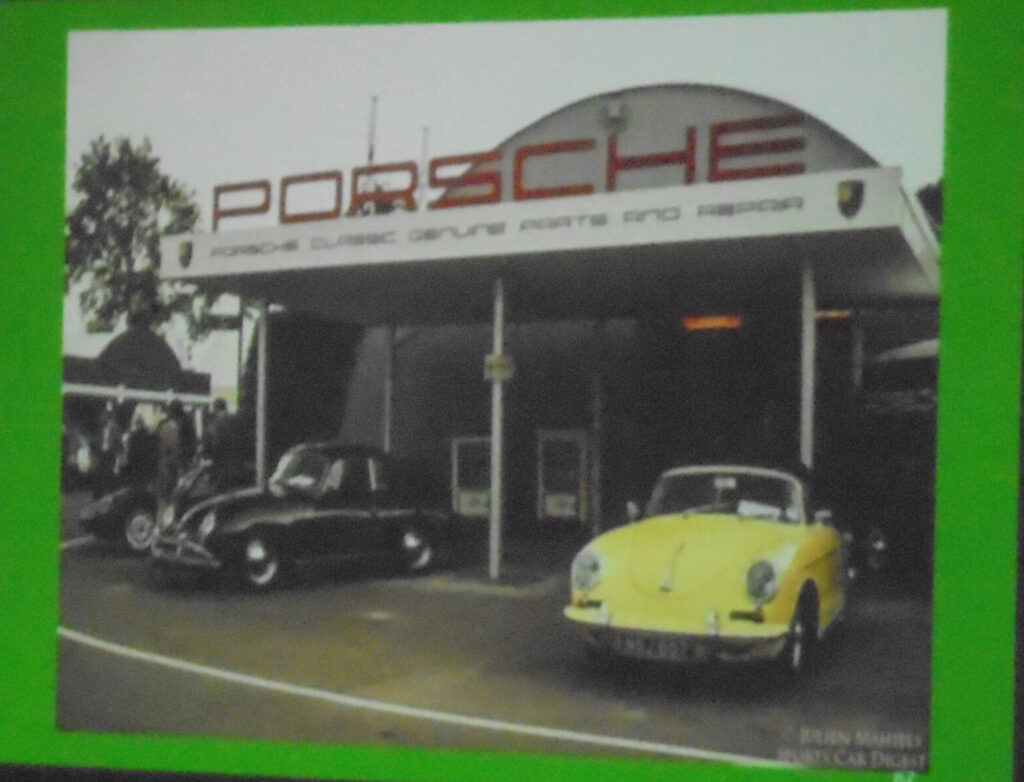
Martin showed many photos and related the stories of many famous cars, racing drivers and celebrities that you can rub shoulders with, at Goodwood,
Martin told us of the story of the 1955 Mille Miglia raced on open roads; it was won by Stirling Moss in no 722, a Mercedes Benz, finishing over 30 minutes ahead of Fangio in his Ferrari.
He concluded his talk with ‘auction’ for the members to value some of the cars that are bought as an investment.


Worksop Town Football Club by John Stocks
John Stocks gave a broad history on the origins of Football starting with the founding in 1860 of the Sheffield Club followed by Hallam FC and Worksop, the fourth oldest club, in 1861. John described how the development of the Manchester, Sheffield and Lincolnshire Railway in 1849 was the umbilical cord of football history. Many local clubs were founded including Swallownest, Anston and Kiveton.
Some famous Worksop matches were the 1907 9-1 loss to Chelsea FC, in the FA Cup and this year is the centenary of the cup match against Tottenham Hotspurs, a team of international players, who, in a massive shock, that made the headlines worldwide, were held to 0-0 draw by Worksop, a team with 9 miners who had come off shift before travelling to London. Worksop were ‘persuaded’ to stay in London and play the replay on the Monday, which they lost.
The original ground was Newcastle Avenue which is now the bus station. The name was changed
In 1889 the Duke of Portland’s horse Donovan won the Derby & St Ledger and won a world record amount winning 18 of his 21 races; Worksop began to be called Donovans and played in the Dukes racing stripes.
John continued the story of the Club and player up to the present day recalling some of the famous players, the move to the Sandy Lane ground, and the wider connections of Worksop Town.
Truths and Myths of Robin Hood and his Merry Men by Keith Small
Keith Small presented an almost forensic dissection of the Robin Hood legend. From examining the hierarchy that existed under the Anglo Saxon rulers and comparing it with that which evolved after the Norman conquest to illustrate the possible motives of the outlaw.
Keith said that although there were several candidates, a singular Robin Hood is difficult to find but the plurality of the character is there, and he is always a Saxon.
He also looked at what records survive of genuine people of the time and constantly asking the question ‘is this our man?’
Keith suggested that Robin Hood could have been a code name for rebel leaders before running through the various members of the merry band, several of whom were only mentioned for the first time in tales written hundreds of years later than the historical context of 1150-1220.
The role of the English archer was examined in depth, to the extent that we learned that at the Battle of Agincourt an estimated 20,000 arrows a minute rained down on the Norman army. It transpires that much of the legend of Robin Hood developed and was embellished in stories told in much later times.
The talk contained a huge amount of information covering three related but perhaps separate subjects, namely Robin Hood and his merry men, the Norman invasion and the long bow and how to use it in battle.

The PowerPoint illustrations had accompanying text which members in the audience with hearing difficulties found most useful.
Origami by Nick Robinson,
Nick Robinson has been practicing Origami for many years and has written 122 books on the subject.
He brought many example of complex items. Before he started speaking he made a pip for our Speaker Finder Derek. He soon had us all folding paper, making a box and finally a book mark.
Nick explained that origami is international and has a universal language of symbols., which is much easier to understand than the examples we grew up with in Rupert Annuals


Change of Speakers
The speaker on 22nd September is now Origami by Nick Robinson,
Build a Boat by Andrew Beard moves to 26th January and Retford and Worksop Brewery by John Stock moves to 5th April
Welbeck Brewery by Claire Monk
Claire Monk who was one of the founders of Welbeck Brewery gave us a brief history of Welbeck from the days of the Abbey to the Cavendish / Bentinck family.
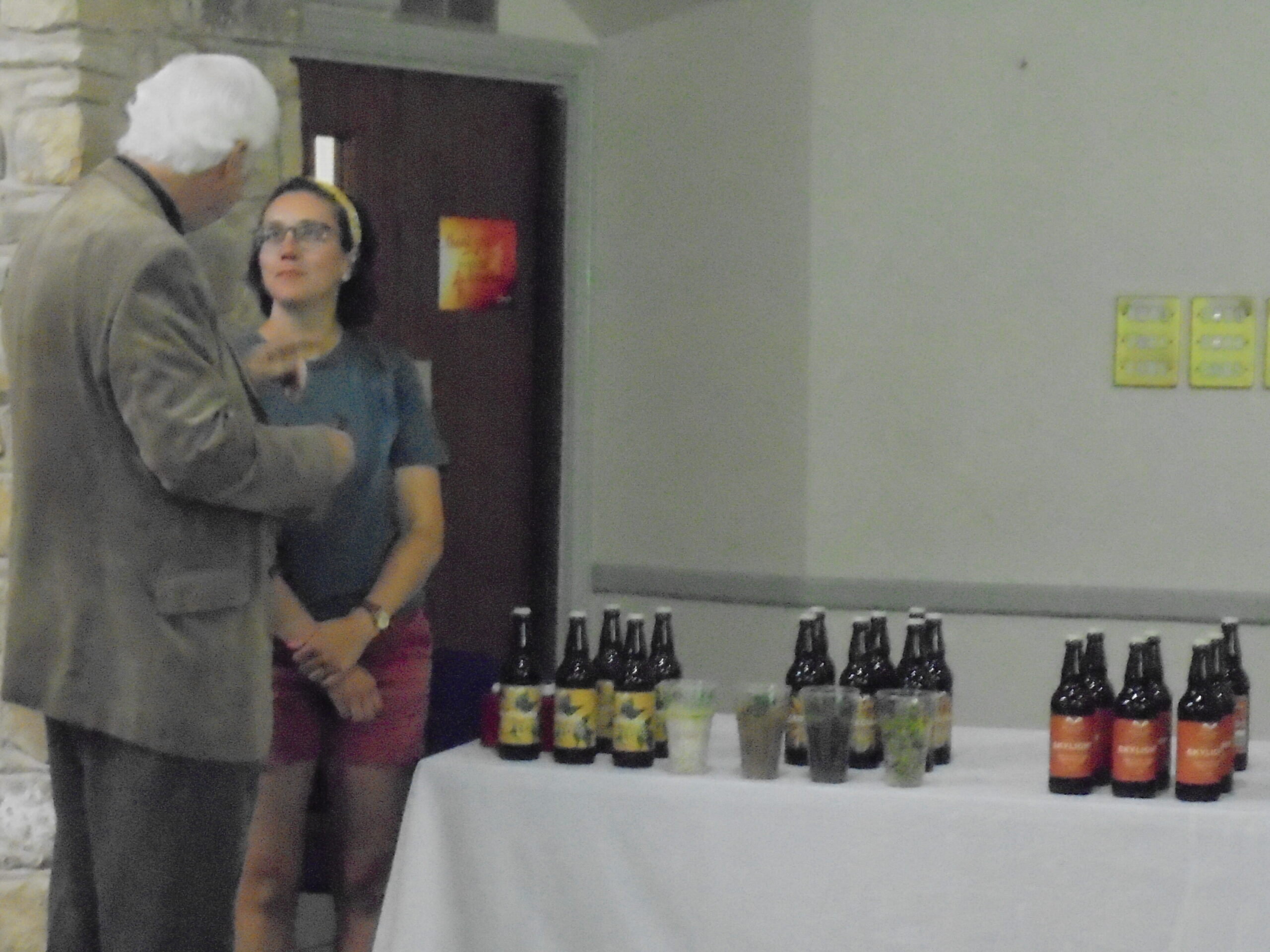
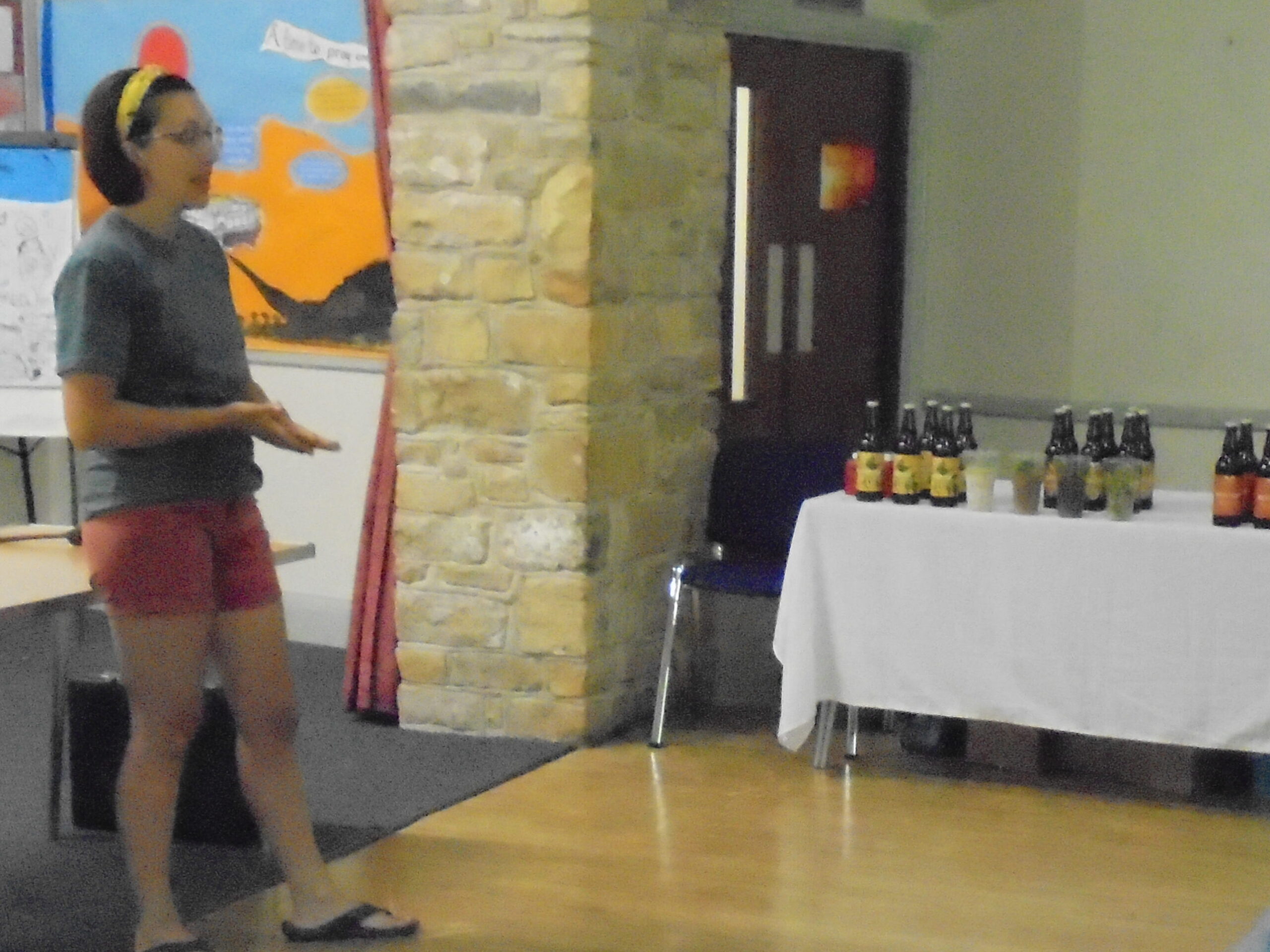
The brewery was founded 12 years ago where Clare brought a bucket of yeast form the Kelham Island Brewery and water from its own bore hole. Members were able to sample four different malts and some hops. Clare described the brewing process and how the flavours changed from where the hops were grown, the East Anglian malts Welbeck brew four regular beers and three specials and Clare had some bottles for members to purchase. At the end of the meeting some members went to the Grey Horses to sample the Welbeck beer on draft.

The Chairman Allan Colley presented the 25 Year Probus Membership badge to Michael de Torre who joined in January 1998
New Season of Talks commenced 8th September 23
Philip Smith who gave his talk at very short notice, on A Life in the Navy on his uncle Ernest Hathaway – a Life in the Navy, who had joined the navy in 1933, and unusually for the time took a camera with him and left a large archive of photographs and memorabilia.
He started as Boy 1, then 2, next an Able Seaman etc; he had accelerated promotion on every ship
From March 1936 to 1939 he served on HMS Achilles on a tour from UK round the South Pacific
He saw action as a Leading Seaman Gunner on the destroyer Verity at Dunkirk & Calais.
As a PO trainee officer, he served on Sheffield was involved and hit by Bismarck, and on the Artic Convoys and needed repairs in Rosyth in July 42.
He was involved on Destroyers in the tumult in the Med as a PO Gunner.
During all this time Ernest was taking photographs which formed the basis of Philip’s talk.
In 1947 he was again in the far East, but did return to Britain in 1853 for the Coronation Review
In 1948 he was commissioned Gunner on Scarborough
In 1958 he witnessed the thermo-nuclear bomb.
When Ernest retired as Lieutenant in 1960, he had spent 25 years at sea.
During most of this time his girl friend had been waiting from 1933 to get married; she trained as a nurse in Sheffield, and she was injured by shrapnel in the Sheffield bombing raid. Ernest returned home and they eventually married in 1960
Alan Beattie gave us a history of the South Yorkshire Aircraft Museum, starting form its beginning in the mid-60s when a group of enthusiasts had a room at Nostel Priory. In the mid-80s it had outgrown its room and moved to the original site of RAF Firbeck with a Bristol Sycamore helicopter, a Jet Provost and some engines; it was visited by other enthusiasts.
In WW1 the Flying Corp flew from Town Moor and sold off their planes to the wealthy at the end of the war
In the 1930s the airfield in Doncaster was created to re-fuel biplanes as it was in the middle of the country. Once international arrived it became Doncaster Airport.
It was visited by famous pilots Cobham & Codie, and used by wealthy visitors to Doncaster Races.
In 1938 a number of buildings were built, and both Lysanders and Battles were built. In WW2 Doncaster was a transport base and the 616 Royal Auxiliary Air Reserve was the first transport squadron formed. 616 was the only squadron equipped with jets during the war.
In 1955 the local Water Board leased the hanger and two buildings, the control tower became a night club and most of the other buildings were bulldoze, although the airfield was still in use.
In 1998 the Water Board vacated the buildings, the local authority offered the lease to the Museum; however, in the 18 months it took to complete the handover, the buildings were vandalised, requiring a lot of patching up. The runways were dug up to create the lakes.
Alan Beattie joined the Museum in 2002 when the York Helicopter Group moved from Elvington to South Yorkshire. He was involved in dismantling and moving a Westland helicopter from Cornwall to South Yorkshire, it was the first helicopter to land in Antarctica and Falklands.
The Museum has one of the most comprehensive commemorations of Falkland’s War and a Memorial. In 13 years it has grown from 50 to 100 complete aircraft and cockpits including Lightning, Vulcan and Canberra, and an increase in visitors from 8.5k to 22.5k
Sam Glasswell, the Curator of Bassetlaw Museum, made a return visit, this time presenting The Carlton in Lindrick Knight, The Knight which is about 2 inches high, unique; it was found by a metal detectorist in 2004 in Carlton. The knight is wearing armour and carries a shield, and is mounted on a horse. i
By comparing it to examples of known date such as the Bayeux Tapestry, it is possible to date the knight to be between the 11th and 13th century. It is made of copper alloy. The base is not flat which suggests that the knight was originally mounted on something, and there has much discussion of what that could have been, but nobody knows. Sam explained that Bassetlaw Museum were offered the the knight but the owners would not accept the expert’s valuation, so tit was sold privately. In 2006 it was sold abroad for £34k but the government put an embargo on its export; and the Museum had three months to raise the money which with a number of grants, they manged to do.
Sam compared the Knight to the Lewis Chessmen in the British Museum, if it was a chess piece then the value would be much higher.
Nicholas Kitchen talk on A Miscellany of Vintage Vehicles was a journey through the history and development of tractors, farm implements and associated vehicles. He has collated an extensive historical picture library from local farmers and enthusiasts, which he used to demonstrate and illustrate his talk.
Simon Cook gave an innovative talk on many of the American Presidents with many insights. Nuggets included that Jefferson’s library became the Library of Congress, four Presidents dies on 4th July, including two signatories to the Constitution who died on the same day 50 years later. Vice-president Harry Truman had only met the President twice and new nothing of the nuclear bomb when he became president 100 days after the inauguration in 1945.
Mike Kane gave us the insight in the World of Quizzing. He started in a quiz team in South Cumbria and became the local Mastermind. He appeared in 15 to 1, then Brain of Britain in 2003with Robert Robinson, and reached the Final of Mastermind with John Humphries in Manchester in 2004. Unlike in the modem Mastermind finals, the cameras just followed Mike in his garden and on the beach. It was interesting that Mike remembered the Questions he got wrong. Mike went on to write quiz questions for Sky Sports and GCSE History & Literature. Mike is now in a Quiz Team in a league of expert quizzers including some ‘Eggheads’, that meet on zoom. We finished with us forming teams and answering Mike’s questions.
Sam Glasswell, the Curator of Bassetlaw Museum, gave an fascinating talk on the Wampanoag who were the native Americans who helped the Mayflower Pilgrims after they landed in America. Sam described how, before the Mayflower arrived, many native Americans died from illnesses brought by the European sailors. Th settlers found empty settlements. Eventually two Wampanoag who could speak some English started conversing with the settlers; this helped the survival of the pilgrims, and lead to trade . Sam brought this up to the present time when four members of the Wampanoag visited Retford and built a Wampanoag hut in the grounds of the museum and described their way of life in September 21.
There was a last minute change of speaker on November 11th when Stephen Gay, one our regular speakers, stepped in to give his illustrated talk on the Hope Valley Line from Sheffield to Edale. Stephen showed many pictures that the train passenger would often miss, such as the closed stations eg Heeley, and engine sheds at Millhouses, as well as closed branch lines especially those used to bring the stone from the quarry for the construction of the Derwent Dams. Stephen explained that the flooding of Sheffield station in 2007 was caused by a tree trunk at the confluence of the Porter Brook and Sheaf under platform 5.
Our Speaker Finder Derek Taylor was the last minute change of speaker from Nigel Macknight at the October 28th meeting. Derek had started writing short stories during lockdown and took the opportunity of the cancellation to present a selection of them to our members. This was Derek’s first ‘public appearance’ and was most enjoyable. Members recognised some of the locations and scenarios, and were thoroughly engaged in the stories which each had a twist in the tale. We look forward to more tales in the future.
The September 30th talk was very timely when Mike Ogden took us through the bloodlines of our Monarchs from Alfred the Great to Charles III, following the ancestry as it travelled beyond England to Scotland, Flanders, Normandy and Germany.
The talk on the 16th September was a fascinating talk by Elaine Perkins who was in costume as Agnes Peterkin as a ‘Cunning Woman’ from the middle ages telling us about Concealed Objects and Hidden Charms
Have you had a run of bad luck? Do you suffer from unexplained pains? Is your husband being led astray? What can you do? Who can help? Agnes Peterkin, The Cunning Woman, is the answer to all of your problems. She can offer you protection from serpents, thieves and even fairies, with a variety of found and made objects which are displayed and explained. She can even keep the Devil at bay!(Written charms and curses are her speciality.)
The first talk of the season was a with a hands-on demonstration and talk of beekeeping from two members of the local Beekeeping Association, who brought an array of beekeeping equipment and a some live bees where we could identify the queen